
Is Your Loved One Grieving?
Dear Family and Friends of my Grieving Clients,
A dear one of yours is now in the sacred territory of grief. I know you want to be supportive and that’s why I’m writing this letter to you. All loss unmoors and disorients us, but the death of a sibling and the death of a child are the most painful and difficult losses.
Years ago, Pam Duke, a mother whose child had died, said these wise words to her Compassionate Friends group::
Grief is a 24-hour a day job. Bereaved parents and siblings are expected to handle this full time job along with their paying full time job and their other activities as if nothing has happened. How many have heard the question “When are you going to be over this?” The answer is NEVER. Parents who’ve experienced the death of a child will never be able to turn off the grief or “leave it at home.” We need patience, understanding AND COMFORT from those around us. We need your support and strength as we go through our grief journey.
I heard those words for the first time in September 1997, at my first Compassionate Friends meeting, just months after my 17-year old son Logan was killed in a car accident.
What I know now is that—during the first 2 years after a loss that big—our grief is intense and painful, demanding that we metabolize and integrate it in a way that expands and matures us, so that we can bring more presence, love and compassion to the world. All I knew then is that the grief was intense and painful and I had limited capacity to function.
So what do you most need to know, in order to help your loved one through this first 2 years after a major loss? First, the Ring Theory. Then, the Needs.
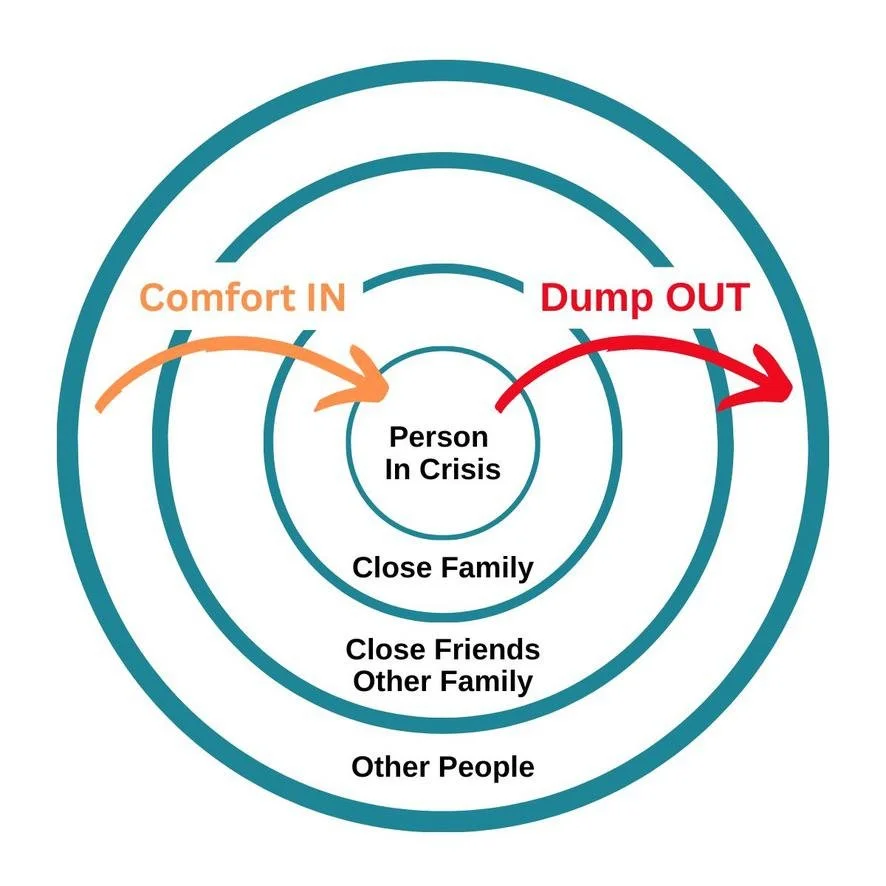
Comfort in; Dump out (aka the Ring Theory)
During a time of crisis or loss, we sit at the center of a set of social circles or rings. Those of us who are closest to the loss fit into the center, the smallest circle. Our family and chosen family are in the next ring out. Social and work connections are in the outermost rings.
The “comfort in; dump out“ rule, which was developed by psychologist Susan Silk, is that comfort needs to flow from the outer rings to the innermost ring. Anytime you are connecting to the innermost ring, you only bring support and comfort.
If you are in an outer ring, you process your own grief and find the support you need with those in your own outer circle. You never dump your grief on those in the center circle whose grief is more intense.
The Needs of a Bereaved Parent
Here’s what Lonnie Forland wrote about her own needs during the 2 years after her 10-year old daughter Carrie’s death from leukemia:
Please let me mourn. I’ve never lost a child before and I don’t understand all the emotions I am feeling. Will you try to understand and comfort me?
Please let me mourn. I may act like I have my act together, but I do not. Often it hurts so much. I can hardly bear it.
Please let me mourn. Don’t expect much from me. I will try to help you know what I can and cannot handle. Sometimes I am not always sure.
Please let me mourn. I need to talk about my child. I need to hear you say my child’s name. Don’t pretend nothing has happened; it hurts terribly when you do.
Please let me mourn. My tears are necessary and needed and should not be held back. Please don’t be afraid of my tears and grief.
Please let me mourn. What I need most is your care, your friendship, your support, your understanding, your prayers. I am not the same person I was before my child died. I never will be that person again.
Please let me mourn. Thank you for helping me get through the most difficult time of my life.
So here’s what I recommend to you as you support your loved one/s through the first 2 years of grief after the loss of a child/sibling:
Acknowledge the ongoing impact of the loss. As we come out of shock in the first months after the death, the pain is even more intense and the future feels bleak. We need loved ones who can ask “How are you really doing right now?” and then hold an open-hearted space and listen to us mourn. We need loved ones who can say our dead child/sibling’s name and remember him/her with us.
Help those who mourn get through the holidays, the birthdays, the anniversary. Bring food, do dishes. Make it easy for us to be surrounded by comfort and support as we get through the birthday and holidays without our loved one. We especially need support as the anniversary of our child’s/sibling’s death approaches. It can help to gather at the cemetery, at the site of the accident, at home and mark the occasion together. If you don’t know what to offer, ask “What would support feel like to you at this holiday/birthday/anniversary?”
Comfort in, Dump out. Your job is to resource yourself so when you are with the parents or sibling of the one who died, you are flowing support and comfort, not trying to process your own grief. That may mean you need sessions with a grief coach or long talks with a friend, first. Prioritize yourself; put on your own oxygen mask before you offer support to others.
Understand the purpose and nature of grief. Grief work, well done, expands us, matures us, makes us more present with others and more compassionate as we face of the sorrows of the world. Grief is a natural organic process that will unfold in its own way in its own time. Our grief journey is unique to each of us. There is no one right way to grieve. There is no grief timeline that works for all of us. The greatest gift we can give the grieving is a space of non-judgment.